 DEUCE
DEUCEGolden hour photography on iPhone: when and how
Golden hour is the stretch after sunrise and before sunset when the sun is low and the light is soft and warm. On iPhone, shoot with the sun to the side or behind your subject, tap to set exposure on the face or the brightest area, and keep the warm color in your edit.
Coming soon to iPhone
What is golden hour?
Golden hour is the period shortly after sunrise or before sunset when daylight is redder and softer than at midday. The sun sits low, so its light passes through more atmosphere, which scatters the blue and leaves warm tones (Golden hour on Wikipedia)). Shadows are long and gentle, and highlights are less harsh than at noon.
The length changes with the season and with latitude. Near the equator it is short. At higher latitudes it can stretch for a long time. Look up local sunrise and sunset for your date, and plan to arrive early.
How do you find the time for golden hour?
Check sunrise and sunset times in the Weather app, then count roughly an hour after sunrise and an hour before sunset as the window. Light changes fast at the edges, so arrive 20 minutes ahead. A weather app that shows cloud cover helps too: thin high cloud softens the light, and thick cloud blocks the warm color.
How do you expose golden hour on iPhone?
- Open Camera and frame the shot.
- Tap on the subject, or on the brightest area if you want a moody silhouette.
- Slide the exposure control down a little to protect the sky. Low sun makes highlights clip easily.
- Hold the focus lock by pressing and holding on the screen until AE/AF Lock appears, if the subject moves.
- Shoot a few frames at different exposures. The best one is often slightly darker than the preview.
Which direction should the sun be?
Side light shows the surface of clay, the lines of a court and the grain of a green. Backlight gives dust and sweat a glow.
| Sun position | Look | Good for |
|---|---|---|
| Behind the subject | Rim light, glow, silhouettes | Portraits and strong shapes |
| To the side | Texture and depth | Courts, fairways, surfaces |
| Behind you | Even, saturated color | Landscapes, quick snaps |
| In frame | Flare and halation | Mood shots with bright points |
Which sports and places look best at golden hour?
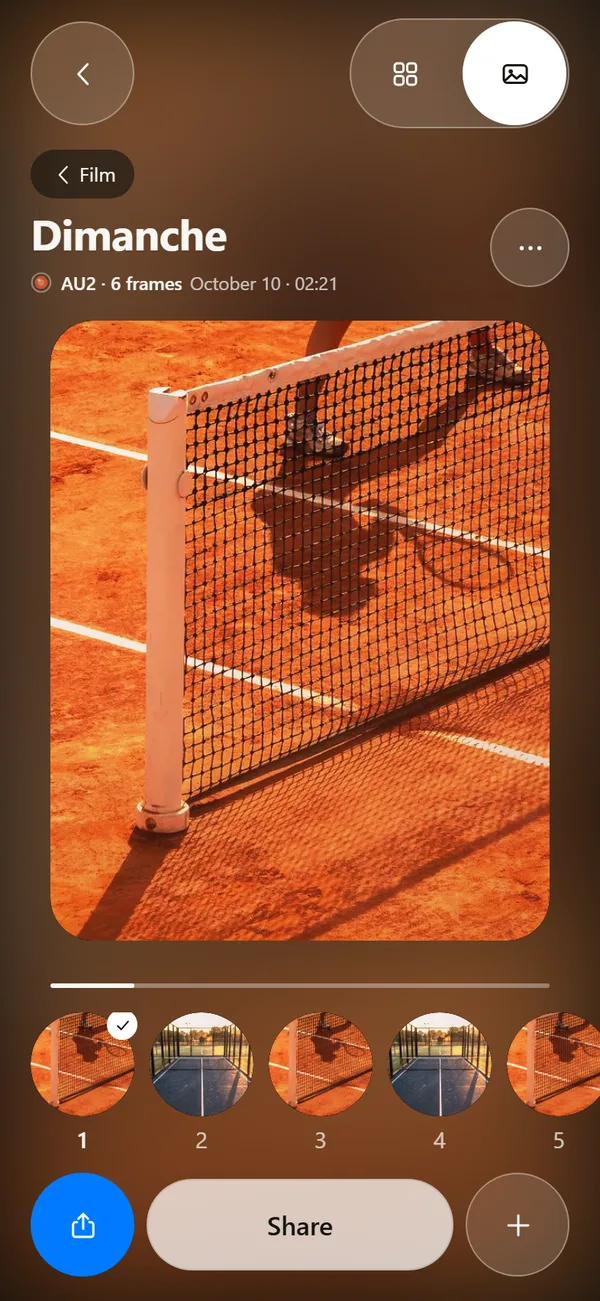
Clay courts turn deep orange in low sun, and the white lines pop. Padel glass walls pick up gold and make strong reflections. A golf course at dusk gives long shadows across the fairway and a soft backdrop for a swing. Early morning frames carry mist and dew, and evening ones carry warm skin tones.
Stay aware of players: low sun can blind them, so shoot from the side during play.
How do you keep the warmth when you edit?
Automatic white balance often cools the picture back toward neutral. If your photo lost its warmth, raise temperature a little and check skin tones. Do not push it far, because orange faces look wrong. Lift shadows slightly and pull highlights down to hold detail near the sun.
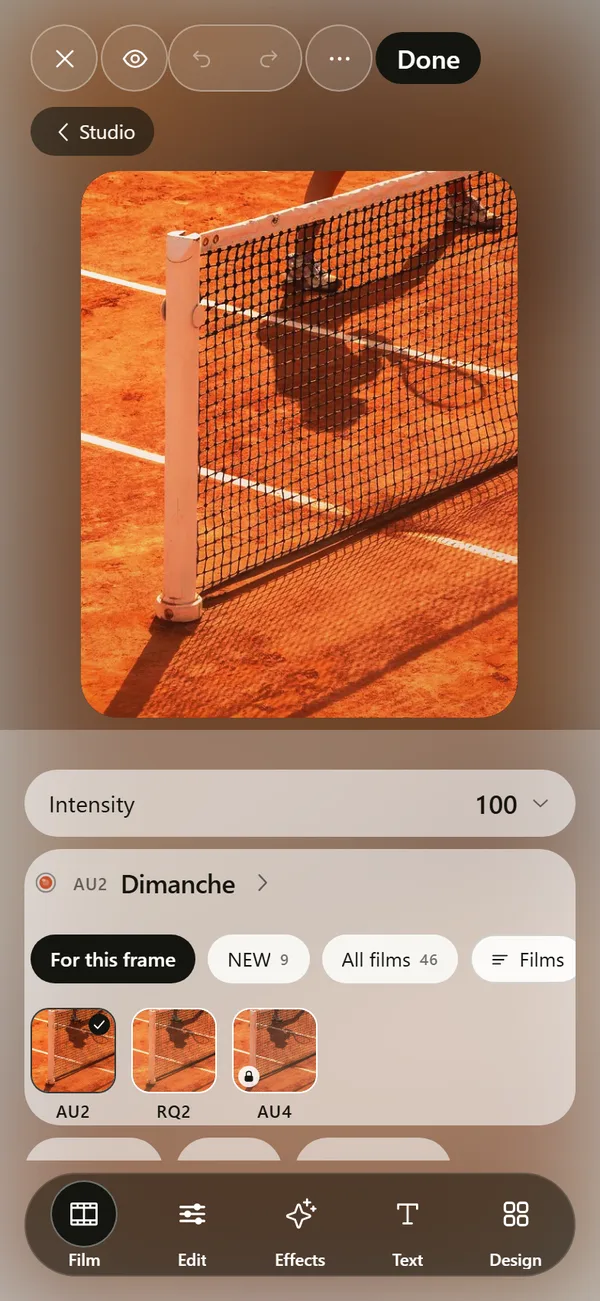
A film look helps. Many films in the film catalog are built around a kind of light. For low sun on a court, look at the warm, dense looks, then set the intensity around 60 to 80 and compare with the original. The photo editor lists the temperature, tint and split tone tools.
What about sunrise and the roll idea?
DEUCE uses sunrise in a different way. A roll of 12, 24 or 36 frames stays hidden until your local sunrise, then develops. Shooting at golden hour and seeing the frames the next morning gives the ritual a natural beat: you shoot in the evening light, you wait, and at dawn the roll is ready. The sunrise roll guide shows how it works.
Which mistakes spoil golden hour photos?
- Overexposed sky because the phone exposed for the shadows.
- Faces lit from behind with no fill, so they fall into shadow.
- Over-saturated orange from a heavy filter on top of natural color.
- Arriving when the best light has just ended.
- Shooting only wide, with no details such as hands, shoes or a net.
What comes after golden hour?
Blue hour follows sunset and precedes sunrise, with cooler, dimmer light. Lamps and floodlights turn on, which makes it good for halation and moody court shots. Keep shooting for 20 minutes after the sun sets.
How should you use the camera grid and lenses?
Use the grid to place the horizon on the upper or lower third, not the middle. With low sun, place the subject on a third line and leave space on the side the sun comes from. In DEUCE the camera shows grid options of thirds, golden, center and safe, and four lenses: 24, 35, 55 and 85 mm. A longer lens at golden hour compresses the background, so distant lights and walls look larger and softer behind the subject.
Is golden hour useful for black and white?
Yes. Low sun gives strong shadows and clear shapes, which is what black and white needs. A court line, a net shadow or the edge of a bunker turns into a graphic element. Try the same frame in color and mono, and keep the one with a clearer subject.
A one-evening plan
- Check sunset time and arrive 30 minutes earlier.
- Shoot wide scenes first while the light is still bright.
- Move to portraits and details as the sun drops.
- Shoot into the sun for 10 minutes to catch flare and glow.
- Stay for the blue hour and capture lamps and glass.
- Review the pictures the next day, since a night of rest improves your editing choices.
Frequently asked questions
How long is golden hour?
About an hour after sunrise and an hour before sunset as a rule of thumb, but it varies with season and latitude.
What is the best iPhone setting for golden hour?
Tap to set exposure, lower it slightly to protect highlights, and lock AE/AF if the subject moves.
Why do my golden hour photos look flat?
The sun may be behind clouds, or the phone cooled the white balance. Raise temperature slightly and add contrast.
Can I add golden hour warmth to a midday photo?
You can imitate it with a warm film look and a split tone, but harsh midday shadows will remain.
Does DEUCE need my location for golden hour?
No. DEUCE uses location only to compute sunrise for rolls, and you can set a fixed develop time instead.
Keep exploring
Film Roll That Develops at SunriseShoot blind and wait for sunrise. 12, 24 or 36 frames per roll. 46 Film Looks for iPhone Photos46 films with codes, series and a comparison divider.
 How to Make Photos Look Like Film on iPhoneFour changes that give a photo a film look: tone, color, grain and glow.What Is Halation in Photography?The glow around bright highlights on film, and how it differs from bloom.